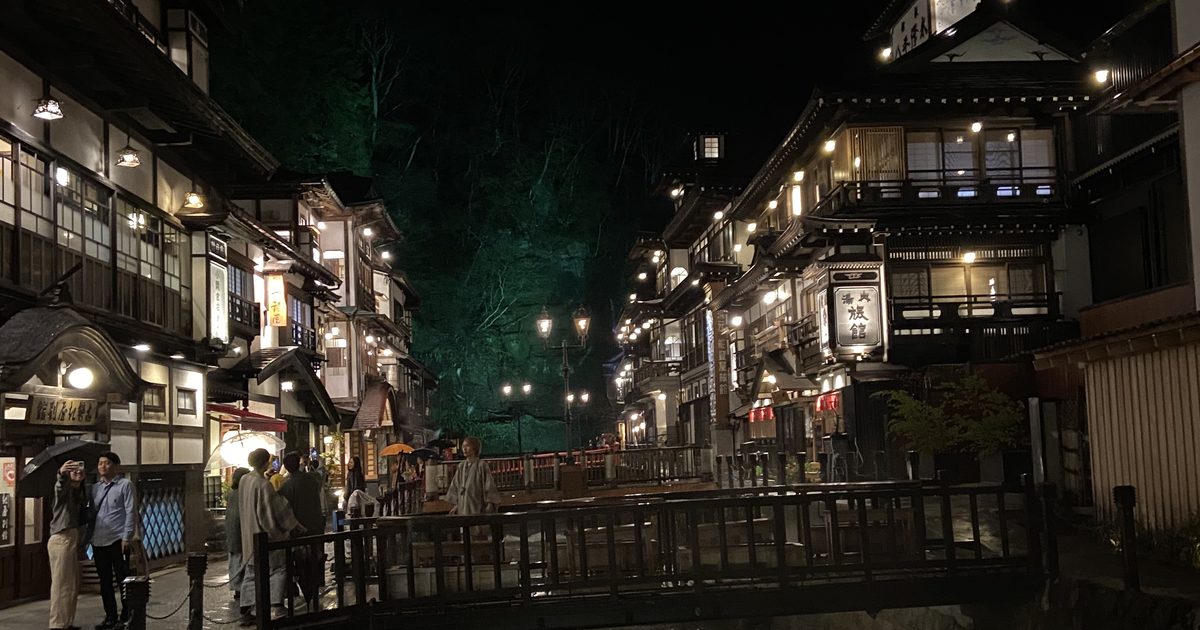
Ginzan Onsen: The Historic Hot Spring Town Lit by Gas Lamps
What Ginzan Onsen is really like — real costs, when the crowds arrive, where to eat, and whether the famous snowy night view is worth the effort to reach it.
You don't have to climb all 2,446 steps: the five-story pagoda and the giant-cedar approach are near the bottom — and a road runs to the summit shrine. A first-hand guide.
Mt. Haguro (羽黒山) is famous for a stairway: 2,446 stone steps climbing through an avenue of giant cedars to the most accessible of the three sacred Dewa Sanzan mountains. Here is what nobody tells you before you go: the two best things on the mountain — the cedar-lined approach and the National Treasure pagoda — are in the first stretch from the gate, and a road runs all the way to the shrine at the top. In May 2026 my family walked to the pagoda, walked back, and drove up.
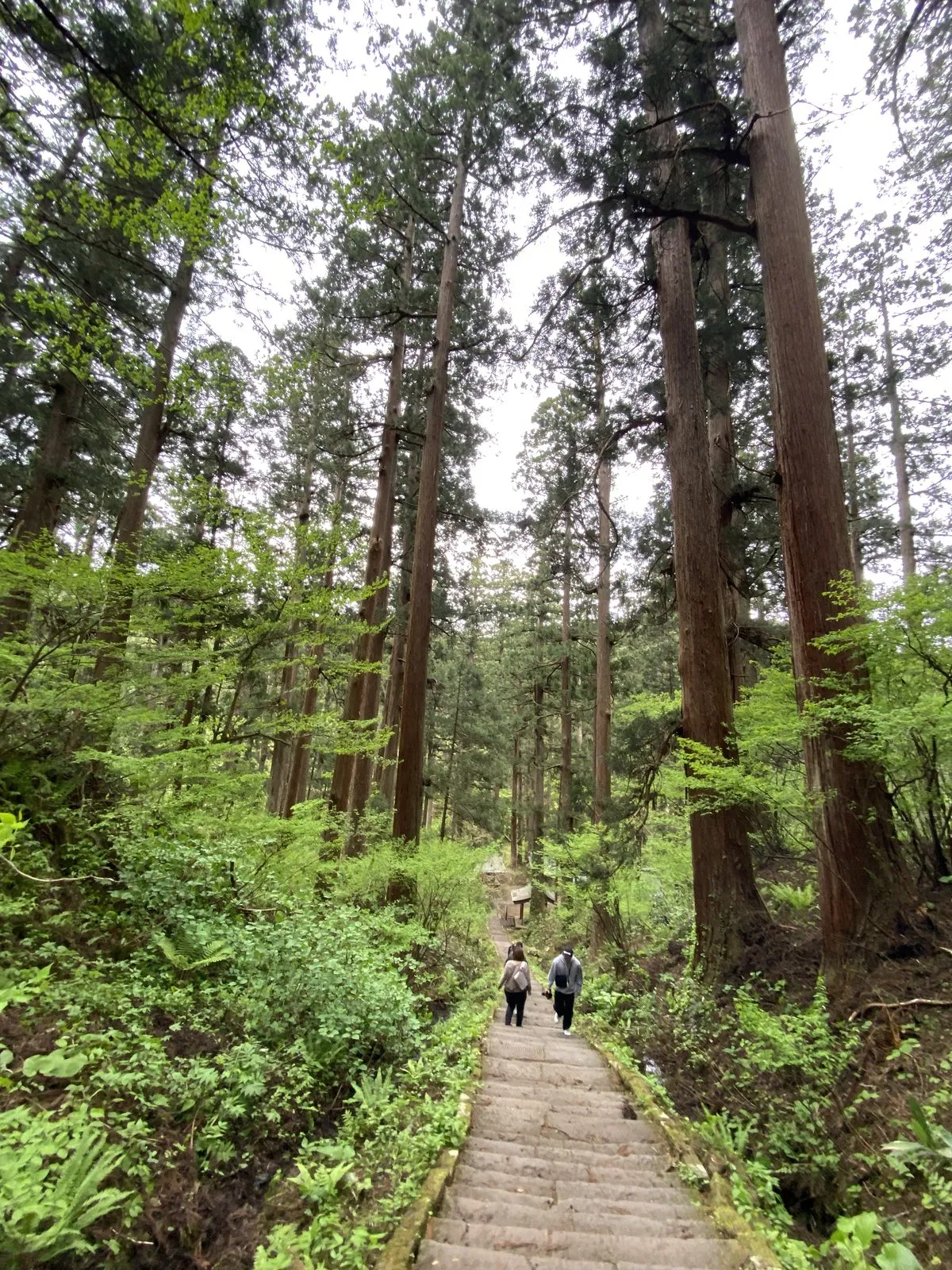
The first stretch from the gate: down through the cedars. Remember — you climb all of this back on the way out.
| The famous steps | 2,446 in total — the pagoda is about 15 minutes from the gate, with real ups and downs |
| Cost | The trail is free; the summit toll road is ¥400 for a regular car |
| No climbing? | Walk gate → pagoda → back, then drive or bus to the summit shrine |
| Time needed | Half a day, comfortably — lunch, the pagoda walk, and the summit fit in one afternoon |
| Nearest hub | Tsuruoka Station; buses serve both the Zuishinmon gate and the summit |
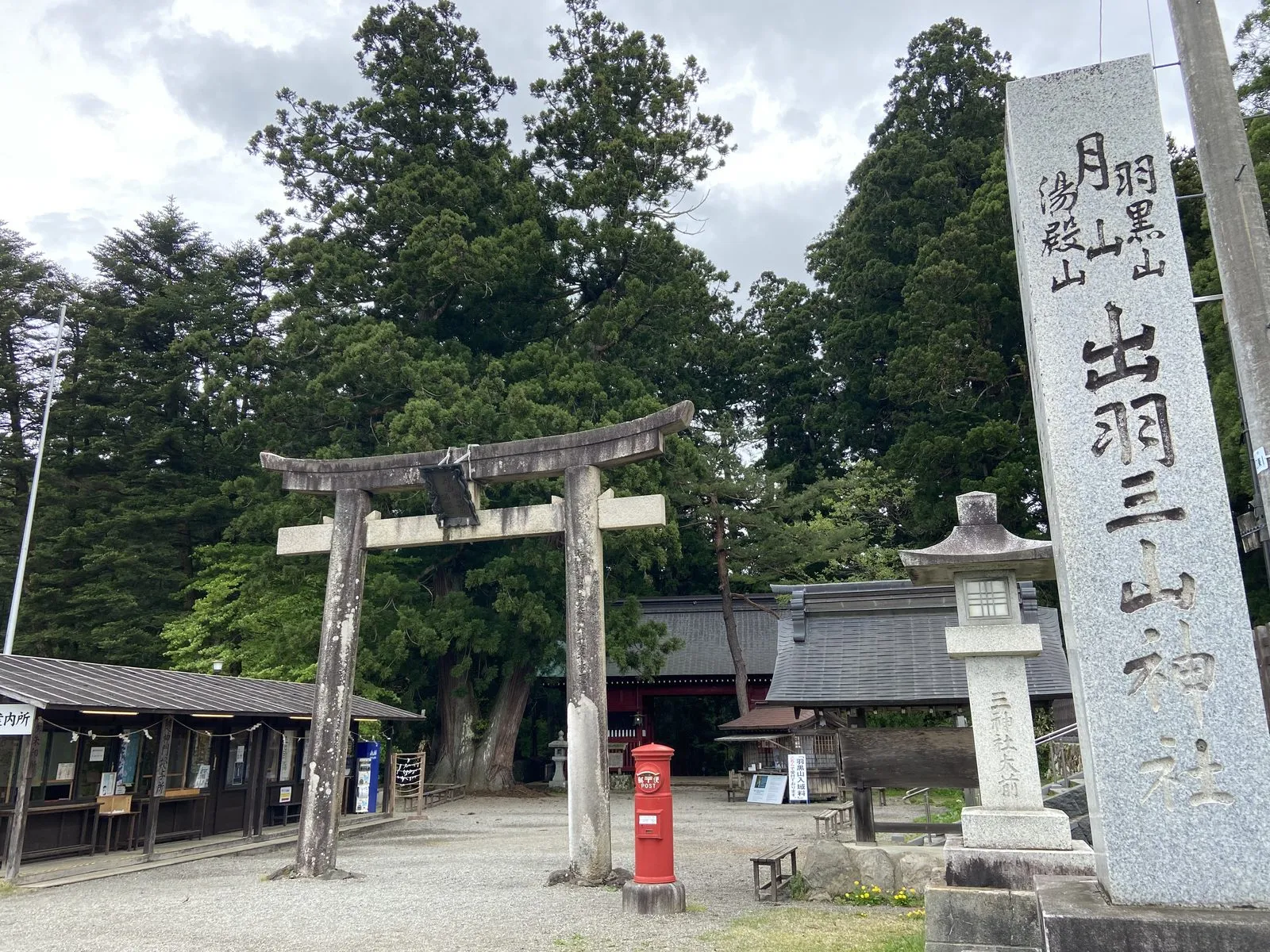
The entrance plaza by the Zuishinmon Gate — three sacred mountains, one stairway (and one very red postbox).
From the Zuishinmon Gate (随神門) the path first drops down into the forest, crossing a red bridge before the long climb begins on the far side. This first stretch is the postcard: stone steps threading between cedars 350 to 500 years old — more than four hundred of them line the route, protected as a Special Natural Monument — their trunks wide enough to block the sky. What I remember is the quiet — just the rustle of leaves overhead, and dappled light falling through onto the stones.
One caution: this is still a stairway, not a stroll. The path drops a fair way before the pagoda, and every step down is a step back up on the way out. Short, yes; effortless, no. And in winter the steps disappear under serious snow — this is heavy-snowfall country — which is exactly why the boot rental at the museum below exists.
Suga Falls (須賀の滝) appears soon after the bridge — a thin veil of water sliding down the rock face rather than a thundering drop, but with a small shrine beside it and a quietly sacred air.
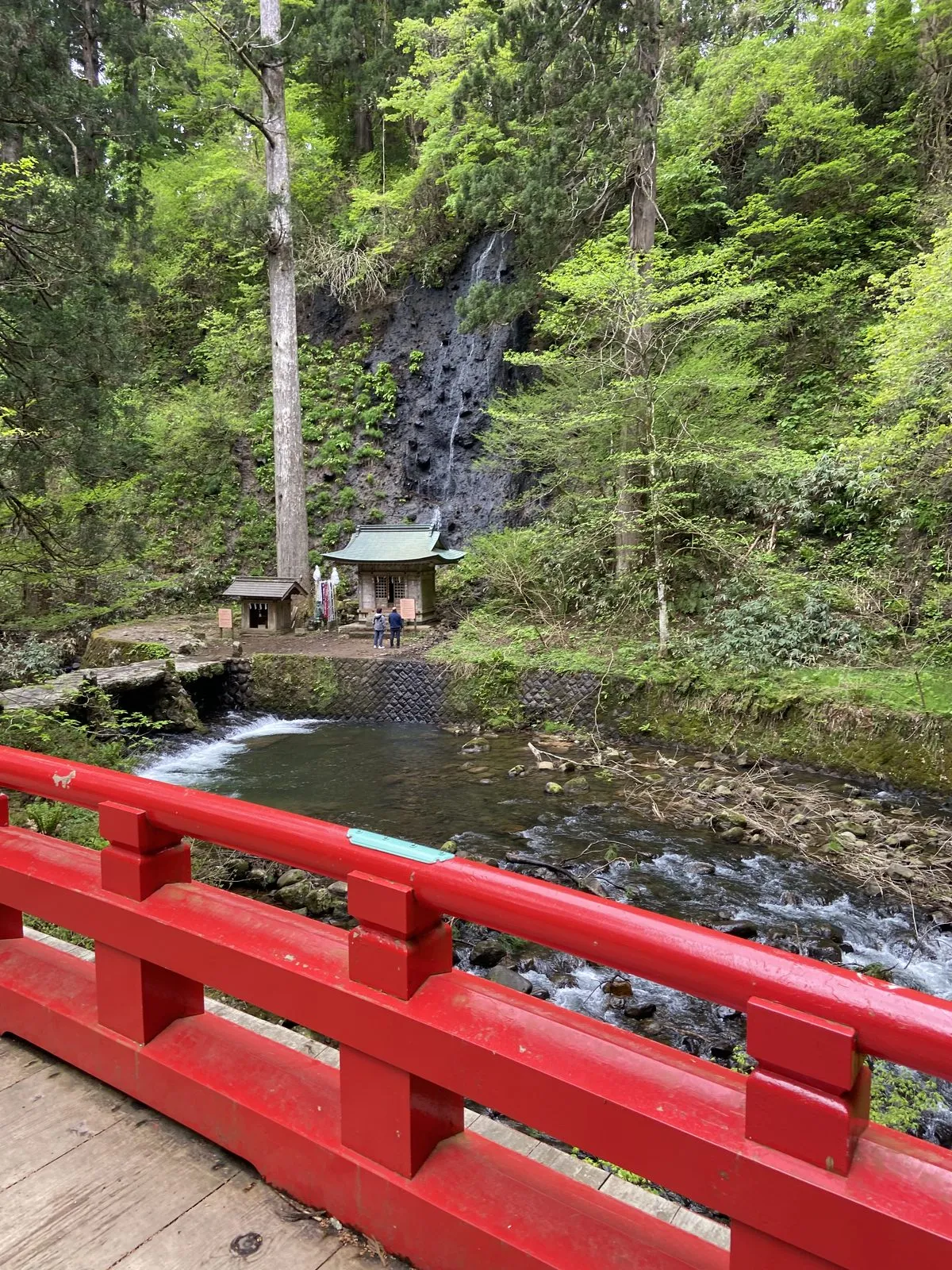
Suga Falls from the red bridge — not a thundering drop, but the little shrine below it earns the stop.
The Grandpa Cedar (爺杉) — over a thousand years old, the biggest tree on the mountain — stands just before the pagoda comes into view.
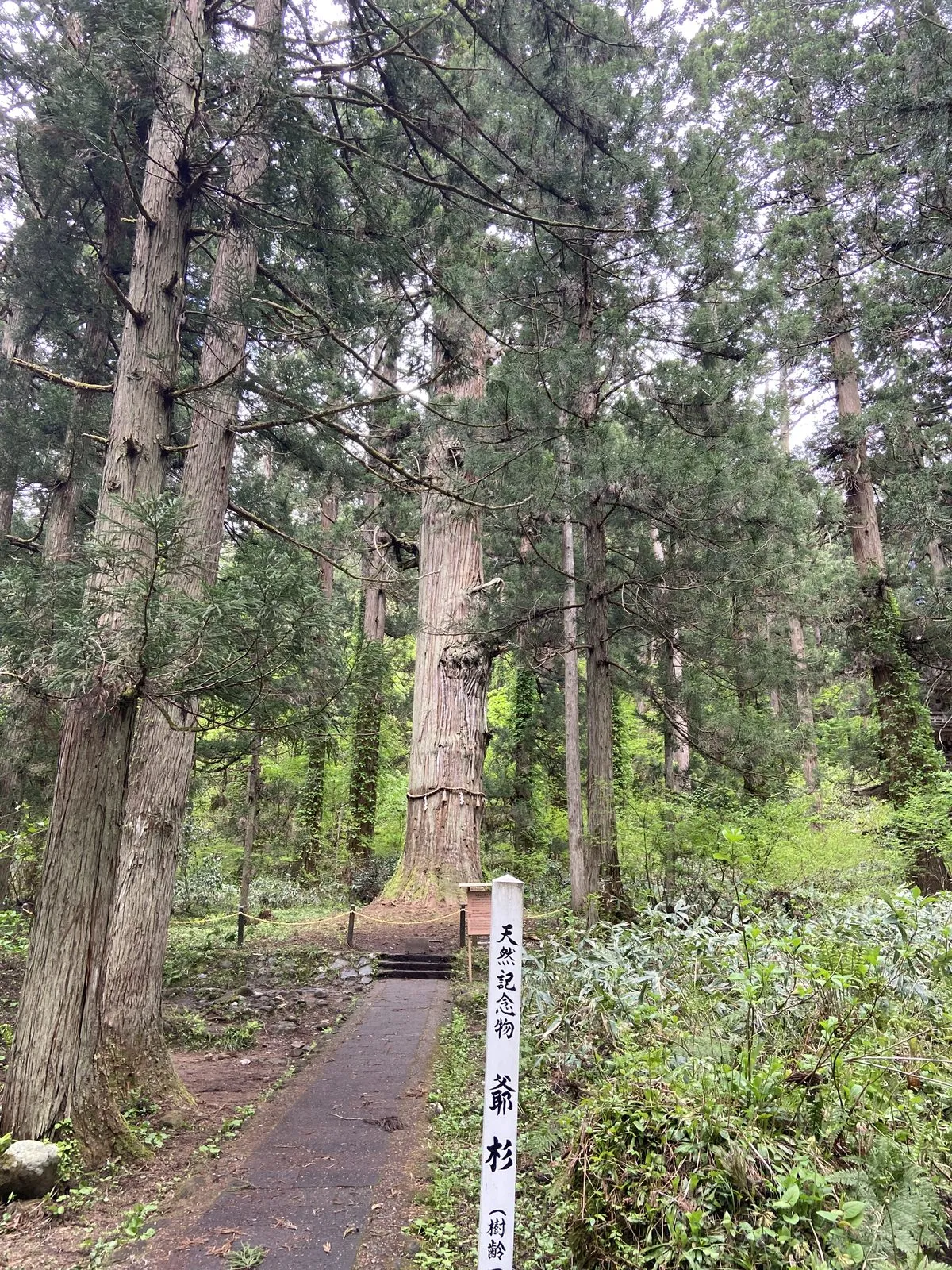
The Grandpa Cedar. More than a thousand years old, and it does not fit in one frame.
The Five-Story Pagoda (五重塔) is the reason most people come: 29 meters of weathered wood, first raised in the 900s and rebuilt some 600 years ago, a National Treasure standing alone among the cedars with no other buildings in sight. A once-in-two-decades re-thatching of its roof kept the pagoda under wraps from 2023 until autumn 2024 — when we visited it stood completely clear, fresh roof and all.
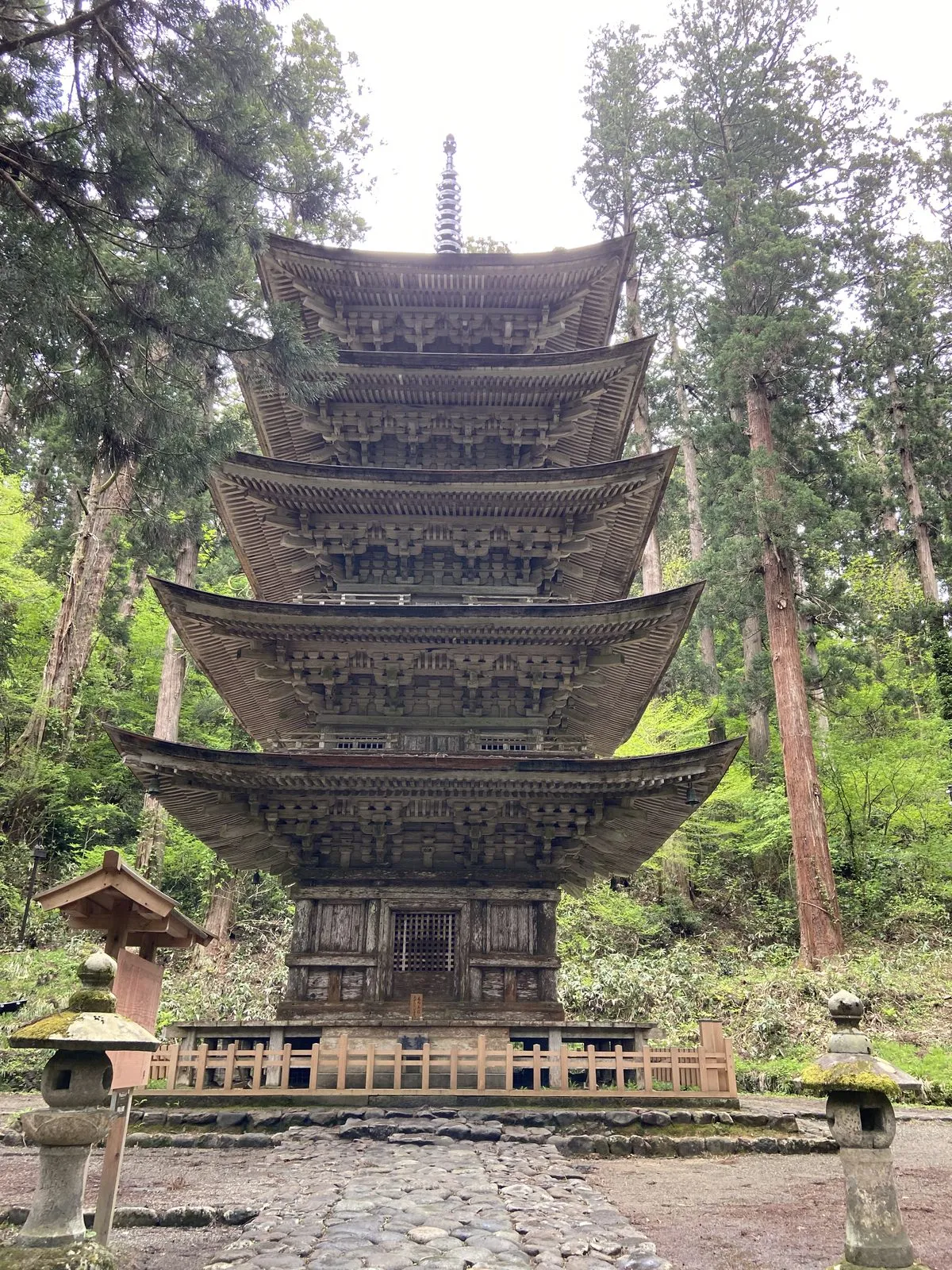
May 2026: restoration finished, wraps off, fresh shingles on all five roofs.
We turned around here and walked back to the gate. If you continue instead, the remaining steps climb roughly another hour to the top — a proper pilgrimage walk, uneven and slick when wet.
A toll road runs to the summit, where Dewa Sanzan Shrine (三神合祭殿) merges the deities of all three sacred mountains — so a visit here counts as visiting all of Dewa Sanzan, convenient since Gassan and Yudono are closed much of the year.
An honest note from our visit, though: when we drove up in May 2026, the great hall was under renovation — scaffolding kept us from a clean view of the building as a whole, though its huge thatched roof was still visible above it. If the summit shrine is the centerpiece of your plan, check the renovation status before you go — for us, the cedar path and the pagoda carried the day anyway.
No car? Shonai Kotsu buses from Tsuruoka Station run about 35 minutes to the Zuishinmon gate and just under an hour to the summit (¥1,400 from the station). Gate and summit are stops on the same line — so you can walk to the pagoda, come back, and ride a later bus the rest of the way up. The no-climb route works fine without a car.
The little town at the gate, Toge, is worth an hour of its own. We had lunch at Okawa Shoten (大川商店) — kamo-nan mugikiri, duck in hot broth over mugikiri, the Shonai region’s own wheat noodle, thinner and smoother than udon. You will not find mugikiri on many menus outside this corner of Yamagata.
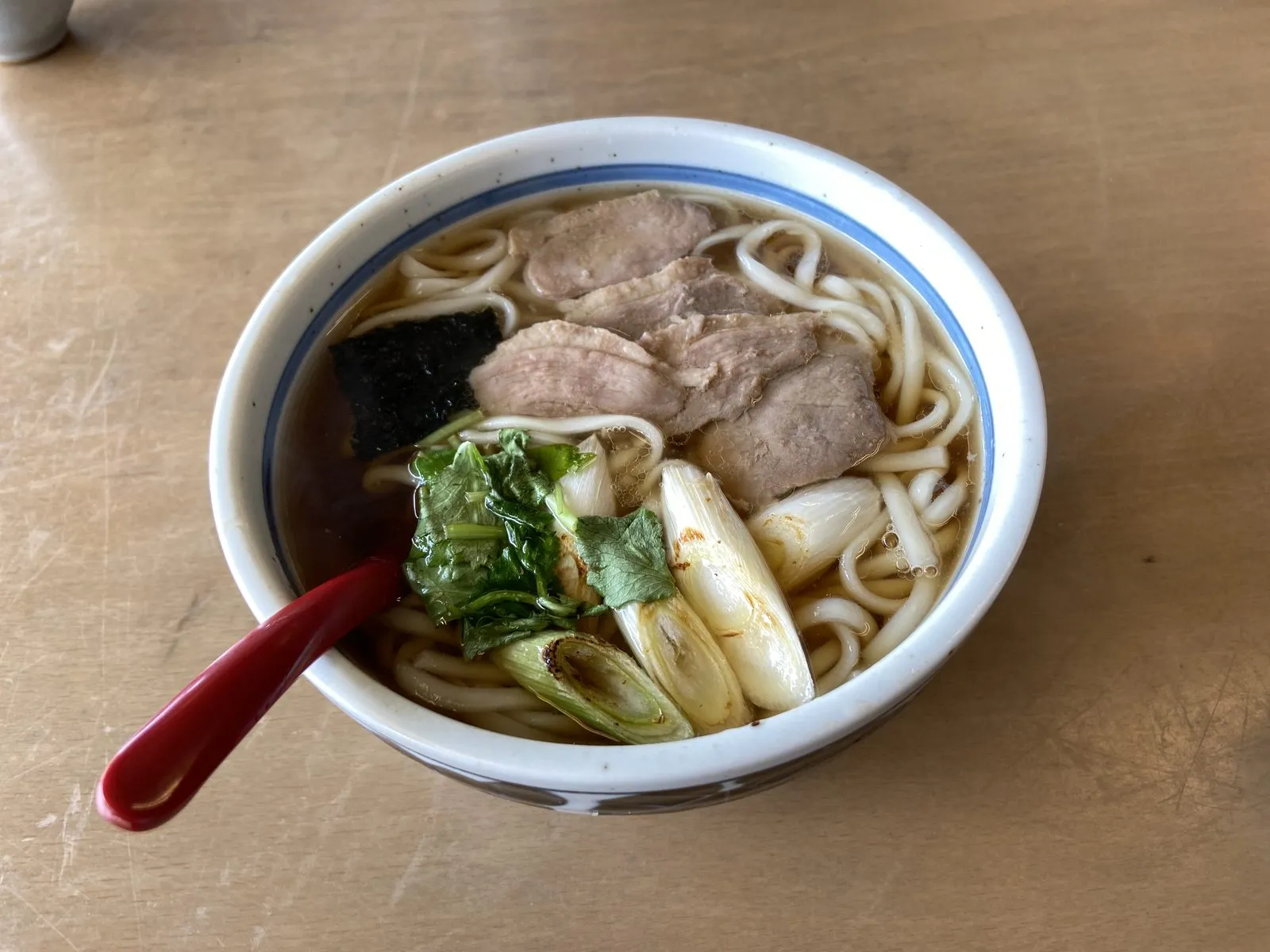
Kamo-nan mugikiri — duck, charred negi, and the Shonai noodle you rarely meet anywhere else.
A few steps away, the Ideha Culture Museum (いでは文化記念館) explains what you have just seen: exhibits on the five-story pagoda and on Shugendo, the mountain asceticism that made these peaks sacred. One practical note we noticed: the museum lends out rubber boots and kongo-zue pilgrim staffs — if you are walking the full stairway to the summit, and especially in winter, stop here before you start.
If the pilgrimage itself is the point for you — the yamabushi mountain-ascetic tradition, the full hour-plus of stone underfoot — climb, and enjoy it. If what you want is the cedar avenue, the pagoda, and the summit shrine, our route delivers all three without the knees paying for it.
From Tokyo, the practical route is shinkansen to Niigata then the Inaho limited express to Tsuruoka, or a flight to Shonai Airport. We came by car, which also makes the gate-then-summit approach easy.
Pair Haguro with Tsuruoka’s jellyfish aquarium (Kamo Aquarium) — the world’s largest jellyfish collection, 30 minutes away — or an overnight at Atsumi Onsen. Both deserve more than a footnote; they will get their own Tsuruoka guide.
Is Mt. Haguro worth it? Yes — and for more people than most “sacred mountain” spots, because the best of it asks relatively little of you. Fifteen minutes from the gate — real stone steps with real ups and downs, honest work but a fraction of the full climb — put you under centuries-old cedars, in rustling-leaf silence, in front of a National Treasure standing alone in the forest. The ratio of effort to payoff is still almost unfair.
Go if you want the old, quiet Japan — the kind Tohoku still does better than anywhere. Families, photographers, and anyone whose knees vote no on 2,446 steps can take our gate-to-pagoda-then-drive route and lose almost nothing. Save the full climb for the day you want a pilgrimage rather than a sight.
What Ginzan Onsen is really like — real costs, when the crowds arrive, where to eat, and whether the famous snowy night view is worth the effort to reach it.
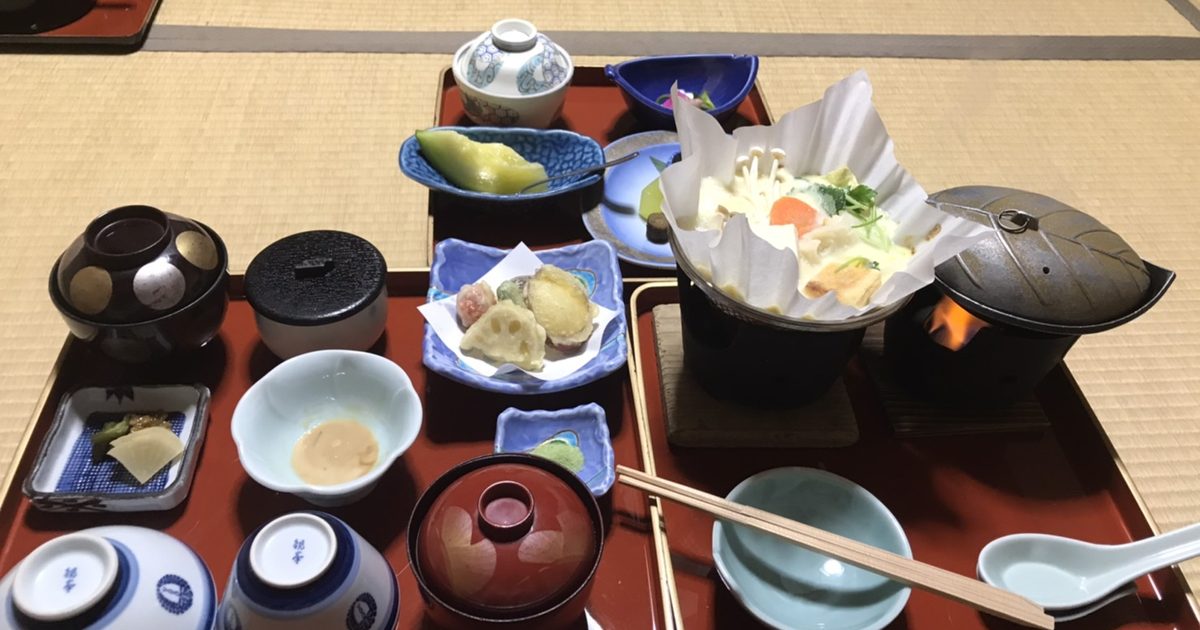
A first-hand account of staying overnight at Fukuchi-in, a Buddhist temple lodging (shukubo) on Mt. Koya — shojin ryori dinner, an onsen bath inside a temple, costs, and how to book.